AROBS Transilvania – custom software development company

AROBS Industrial Automation
- Home
- AROBS Industrial Automation
PLC · Safety PLC · HMI / SCADA · Industrial Edge · IIoT. Platform-agnostic

Industrial automation systems, engineered from the PLC up.
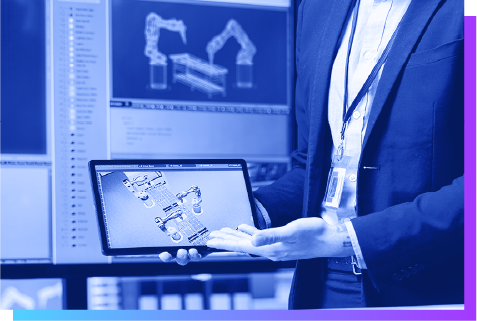
AROBS builds industrial automation from the control level up: integrating existing PLCs, implementing automation with PLCs or safety PLCs, and connecting to industrial edge controllers with industrial I/O.
We are Platform-agnostic across the controllers,
SCADA systems and protocols you already run.
Talk to our industrial automation engineers

BVB Listed Company

Supported by EBRD

1200+ Engineers in 9 countries

Clients in 15+ Countries
The stakes in Industrial Automation
Manual operations still dominate.
70% of manufacturers still enter data manually and 68% still analyze it in spreadsheets, even as data volumes double. (Manufacturing Leadership Council
Invisible losses add up.
Brief stoppages clear before anyone logs them; the aggregate cost of unplanned downtime for Global 2000 companies has reached ~$600 billion a year — up 50% in two years.
We start at the control systems level and add supervision, edge and cloud capabilities where they serve a concrete purpose.
We define automation at the PLC/control layer first. We add supervision, edge, and cloud when they serve a concrete purpose.
We fit the industrial automation project, not a product:
Greenfield
new automation, PLC/control,
I/O, HMI, SCADA, edge, etc.
Brownfield
integration with existing PLCs and equipment, modernisation, protocol conversion, connection to edge.
Non-safety-critical
automation
industrial controllers/edge devices with industrial I/O, without necessarily using a PLC just because it is ‘industrial’.
Safety / deterministic
control
where we use PLC / Safety PLC.
Industrial automation,
Agnostic by design
We work across major automation platforms and standard industrial hardware. No lock-in to a single vendor.
Work with us for your industrial automation process.
Book a working session with our industrial automation team
What we design, program and integrate for integrated automation.
IIoT 2.0 isn’t more dashboards. It’s decisions made on the machine.
Body
The first wave of IIoT pushed everything to the cloud and
waited on it. IIoT 2.0 keeps monitoring, logic and connectivity close to the process — on industrial controllers and edge devices — so the plant depends less on an external link and sensitive process data can stay on-site. How fast a local decision happens depends on the controller, the operating system, and the application; we design each for the response the process actually needs.
Sub-points
• Local monitoring and data processing at the source.
• Condition monitoring and fault detection that surfaces
problems earlier.
• Local logic and coordination close to the process,
independent of the cloud link.
• Connectivity for legacy and new equipment, unified into
one operational view.
Tell us about your industrial automation project.
Book a working session with our industrial automation team
One engineering approach, across solutions and industries.
The same engineering principles apply across industries: define the control requirements first, then add supervision, connectivity and higher-level software where needed.
We define the control first, then add supervision, connectivity and higher layers as needed.
Manufacturing
Machine and process automation, monitoring, predictive/condition-based
maintenance.
Process & Utilities
Pumps, valves, tanks, pressures, temperatures and remote stations.
Water & Infrastructure
Distributed monitoring and control across dispersed
sites.
Energy
Meters, PV, batteries, generators,
grid and load management.
Brownfield
modernisation
Existing PLC + new edge /
SCADA / cloud.
Security by design in industrial automation.
Every gateway added to a plant is another attack surface. For safety-critical functions, we
integrate dedicated PLC/Safety PLC architectures and keep safety functions separate from higher-level edge and IIoT software.
The Romanian National Cyber Security Directorate accredits our cybersecurity practice
Tell us about your integrated automation process. We'll propose the control architecture.
Book a working session with our industrial automation team
Engineers with high expertise in programmable automation
Our background is in embedded software for demanding, safety-critical domains. That gives us engineering rigour and process maturity for complex projects in industrial automation systems. We’re the largest technology company listed on the Bucharest Stock Exchange, with 1,200+ engineers across Europe, the US and Asia, and we stay vendor-agnostic across automation platforms.
We design and integrate automation solutions for industrial processes, production lines and installations.

Plant & automation managers - control design, retrots, and commissioning across a multi-vendor floor.

System integrators & OEMs - PLC, Safety PLC, HMI/SCADA and edge engineering capacity.

Embedded development and testing

Energy sites & storage operators - metering, generation, storage and load management.

Operations & maintenance leaders- modernisation without ripping out equipment that still performs.
Tell us about your industrial automation project. We'll propose the control architecture.
Book a working session with our industrial automation team
FAQ
Do you build new industrial automation, or only integrate what's already there?
AROBS can integrate and modernise existing industrial automation systems or develop new control, HMI/SCADA and industrial edge components depending
on the application. We do not force replacement of equipment that can continue to perform its role effectively.
Do you always use a PLC?
No. We right-size the control to the function. We use a PLC or Safety PLC where determinism or safety requires it, and industrial edge controllers or industrial PCs with industrial I/O where a full PLC isn't needed.
How do you handle safety-critical functions?
With dedicated PLC / Safety PLC architectures — fail-safe I/O and safe-state management — kept separate from higher-level edge and IIoT software.
Are you tied to a specific industrial automation vendor?
No. We're platform-agnostic and work across major PLC / SCADA ecosystems and standard industrial hardware.
Which industrial protocols do you support?
Modbus, Modbus TCP, OPC UA, MQTT, PROFINET, EtherCAT and EtherNet/IP, among others — with the exact set validated per project.
What happens if the cloud connection goes down?
Control continues on the PLC or controller, and the industrial edge keeps local monitoring and connectivity running. Data syncs back when the link returns.
How do you secure connected industrial systems?
Security is built into the embedded and control layers. See our embedded systems security services (link: https://arobs.com/embedded-software-services/embedded-systems-security-development/).
Can you integrate existing PLCs and legacy equipment?
Yes. We can integrate an existing PLC and extend it with new I/O, logic, HMI/SCADA or connectivity, rather than replacing equipment that still performs its role. For legacy equipment, we handle protocol conversion and connectivity so older devices sit alongside newer controllers in one automation system.
When do you use a PLC versus an industrial edge controller?
We use a PLC or Safety PLC when the function needs deterministic, real-time control — or is safety-critical. We use an industrial edge controller or industrial PC with industrial I/O when the function doesn't require that determinism: local data processing, connectivity, monitoring or non-safety logic. The choice follows the application, not a default.
Can you integrate HMI and SCADA systems?
Yes. We build and integrate HMI and SCADA for operator interfaces, alarms, trends, process visualization and remote supervision — connected to the PLC / control layer underneath, whether that layer is new or already in place.
What happens if cloud connectivity is unavailable?
Control keeps running. Deterministic and safety functions stay on the PLC / Safety PLC regardless of the cloud link, and the industrial edge keeps local monitoring and connectivity running. Data syncs back once the connection returns.
What are the four types of industrial automation?
Fixed (hard) automation — Dedicated equipment running a fixed sequence for high-volume production. High throughput, low flexibility.
Programmable automation — Sequence controlled by a program that can change between runs. The classic PLC domain: batch production, changeovers, CNC.
Flexible (soft) automation — Switches between products with little or no downtime. Robotic cells and flexible manufacturing systems.
Integrated automation — The whole plant coordinated as one system, with control, supervision and information layers connected end to end.
AROBS works across all four — defining the control at the PLC / Safety PLC level first, then adding higher layers as needed, platform-agnostic.
Will industrial automation be replaced by AI?
No. AI sits on top of automation; it doesn't replace it. Deterministic, safety-critical control stays on the PLC/Safety PLC layer, where behaviour must be real-time, repeatable, and verifiable. AI works as an optional layer above — using automation data for predictive maintenance, anomaly detection and optimisation — but it doesn't execute control or safety functions.