Automotive software engineering is in our DNA. Our automotive engineering team delivers complex embedded solutions – built on ISO 26262, AUTOSAR, and Automotive SPICE – for the toughest programmes in the global industry. For Tier 1 suppliers and Global OEMs tired of stitching together separate vendors for embedded software, testing, and R&D, AROBS is a single automotive engineering partner that builds vehicle software, proves it’s safe, and keeps building what’s next, including AI-powered automotive solutions. Unlike point-solution vendors, our engineers, in-house consulting, validation bench, and R&D sit under one roof – it’s like a one-stop shop for your automotive projects.
We provide AI-powered automotive software engineering services, including Body Control Modules, Gateway ECUs, Door Control ECUs, power closures, radars, car keys, wireless chargers, instrument clusters, head-up displays, secondary displays, infotainment systems, Testing & Validation, and embedded and telematic units.
Top industry brands in major countries
Our automotive expertise spans software and hardware. Our projects draw on years of delivery for leading automotive brands in Germany, France, Japan, Romania, China, and the USA. Quality isn’t negotiable: every programme is staffed by engineers who live & breathe automotive software, development, and embedded systems.
Who We Serve
Tier 1 automotive suppliers - get safety-critical ECU engineering capacity with an experienced team
EV startups and OEMs - get AUTOSAR-compliant software architecture from concept through SOP.
Mobility service providers - connect fleets and vehicle platforms with secure, scalable software
ADAS & autonomous tech developers - validate perception and control systems against ISO 26262 and ISO/SAE 21434
AI-powered development and physical AI teams - build and validate embedded AI systems, with the first Romanian company with an ISO/IEC 42001 certification from Bureau Veritas
Why AROBS for Automotive Software Engineering Services & Embedded Systems
Broad expertise coverage
Body Control Modules, Gateway ECUs, Door Control ECUs, Car Keys, Instrument Clusters, Head-Up Displays, Secondary Displays, Infotainment Systems, ADAS ECUs, Engine Control Systems, HEV ECUs, Telematics Units, Testing & Validation, and test equipment production.
High-quality work
Our software is built to ISO 26262, AUTOSAR, Automotive SPICE, and ISO/IEC 27001. We deliver end-to-end solutions and standalone product units, with a dedicated team available for any stage of development.
AI-powered solutions
Our AI capability extends beyond one flagship project into everyday quality engineering. Our work includes the AI-Ready Cockpit Domain Controller and its on-device AI assistant and AI-powered sound testing, replacing subjective, reference-based acoustic checks with real-time analysis against client requirements that show roughly 25% fewer errors and 75% full automation.
Proof, within an NDA
Exclusivity and client confidentiality are core to how we work in our long-term automotive partnerships. We have strong experience delivering internationally for Tier 1 suppliers and OEMs, spanning EV programmes, ADAS validation, and infotainment. To discover our work more in-depth, see our automotive case studies.
Software/system testing (vehicle system software development, quality assurance, assurance engineering)
System engineering and safety engineering
Hardware (hardware layout engineering, automotive electronics, bus communication mixed signal/PCB design)
Mechanical (design and prototyping)
Technical project leadership and software project management, all following Automotive SPICE and AUTOSAR standards
Testing & Validation
Proven R&D, including production-ready physical AI systems - see the AI-Ready Cockpit Domain Controller below.
R&D in Action: the AROBS AI-Ready Cockpit Domain Controller
Showcased at CES Las Vegas 2026, the AROBS AI-Ready Cockpit Domain Controller (CDC) is a production-ready reference architecture, not a prototype, running Android Automotive OS on a single microcontroller with hypervisor support. It consolidates safety-critical and infotainment domains that would normally sit on separate ECUs, cutting hardware complexity, bill-of-materials cost, and the late-stage integration risk that slows most cockpit programmes.
At its core is the AROBS Automotive AI Assistant: an on-device AI assistant that processes driver state, vehicle telemetry, and environmental data without a round trip to the cloud. Cloud inference hits a wall with CDCs: latency, connectivity gaps, and data-sovereignty rules that real-time safety systems can’t wait for. Running the model on-device removes the wall entirely. This is what a software-defined cockpit development needs to look like, given the fact that the segment scales: global CDC shipment volumes are projected to grow from 5.4 million units in 2022 to more than 60 million by 2030, a 30.6% CAGR. Clients apply this architectural thinking to their own programme, creating a performant working system.
Engineering the Future with Physical AI. Automotive Engineering Services & Beyond
In 2025, Gess Engineering – a Sibiu-based specialist in vehicle testing, validation, and integration – became part of AROBS Group. With about 100 engineers, the team is recognised for end-to-end testing of advanced driver-assistance systems (ADAS) and other vehicle functions: requirements analysis, test methodology, execution, and final reporting. For AROBS clients, that means a deeper, in-house validation technical expertise sitting alongside the software build – not handed off to a separate vendor.
Expanded Software Engineering Expertise
In 2026, Quest Global Romania joined AROBS Group. The team of about 110 specialists brings integrated software development, testing and validation, design and usability, mobile development, and embedded solutions across Automotive, Healthcare, Semiconductors, and Oil & Gas, for clients across North America, Western Europe, Australia, and the Middle East. The continuous group expansion gives AROBS automotive clients a wider bench for complex, multi-domain programmes – embedded software, hardware, and independent validation – under one group.
Secure Automotive Software Engineering Services
Embedded systems security is one of the essential pillars of reliable automotive software and hardware – and one AROBS builds in from day one, not bolted on after the fact. Our automotive teams design and validate to the standards our clients must meet, backed by our own TISAX and ISO 27001 certifications at the organisational level. With testing and validation capabilities, we can also generate the audit evidence needed – from requirements analysis through test execution and reporting – in-house. AROBS builds following the standards our clients need, including:
ISO/SAE 21434
ASPICE
UNECE R155 (part of ISO/SAE 21434)
ISO 26262 – the functional safety standard, with dedicated provisions for how cybersecurity affects safety-related systems
ISO/IEC 42001
Meet Our Expert
Silvan Morariu
Head of Embedded & Automotive
Silvan Morariu is Head of Embedded & Automotive Software at AROBS Transilvania Software, Romania's largest technology company listed on the Bucharest Stock Exchange, with over 1,200 engineers across Romania, Hungary, Moldova, Poland, Germany, and the United States.
A Computer Science graduate of the Technical University of Cluj-Napoca and holder of an Executive MBA from the University of Hull, Silvan brings a rare combination of deep engineering roots and commercial leadership. He has spent his entire 20+ year career growing from Software Engineer to the executive responsible for one of the company's most strategically critical verticals — embedded systems and automotive software.
With over a decade leading the Automotive & Embedded vertical, Silvan oversees delivery of embedded systems architecture, automotive software engineering, and cross-functional technical leadership, with a strong focus on building scalable, safety-critical, and high-reliability solutions. Silvan is recognized for aligning excellence in engineering, innovation, and business strategy, enabling teams to deliver complex projects across international markets.
Automotive Industry by the Numbers. Electric, Autonomous, Connected
Market overview
Advanced automation
The role of cloud
Big data
Safety concerns
Market overview: the automotive sector
The autonomous-vehicle market is projected to grow from $104.6 billion in 2026 to $378.4 billion by 2033, a 20.2% CAGR. Electric car sales already topped 20 million worldwide in 2025 (1 in 4 new cars sold) and are estimated to reach 23 million, or 28% of total sales, in 2026. Looking further out, the IEA's Global EV Outlook 2026 projects the global EV fleet (excluding two- and three-wheelers) to grow more than fivefold by 2035 under current policies, and around sixfold under its Stated Policies Scenario - bringing EVs to over 25% of all vehicles on the road worldwide by 2035.
When choosing an automotive software development company, organisations weigh both technology and market direction. Deloitte's 2026 Global Automotive Consumer Study finds that global BEV demand remains uneven across regions, while interest in hybrids keeps strengthening as consumers balance affordability, charging access, and everyday practicality. Consumers also place the greatest value on connected features that improve safety and security - even as concerns about data-sharing stay high - a reminder that strong cybersecurity has to be built into automotive software from the start, not bolted on afterwards.
Advanced automation in automotive services
AI and machine learning are making vehicles significantly smarter. Research shows AI systems extend the reach of Advanced Driver Assistance Systems (ADAS), encrypt sensitive data, improve durability, and enhance detection of environmental elements. The global automotive AI market is projected to grow from $18.83 billion in 2025 to $38.45 billion by 2030, with a 15.3% CAGR. Techniques like Convolutional Neural Networks (CNNs) for image processing and Reinforcement Learning (RL) for feedback-driven decision-making are central to that growth. AROBS uses AI and ML to build intelligent systems that analyse data and optimise performance - the same automotive software engineering discipline behind our AI-Ready Cockpit Domain Controller above - which is a major differentiator for autonomous vehicles (AVs).
The role of cloud computing in automotive software
The connected-vehicle market is projected to grow from $86.13 billion in 2026 to $149.56 billion by 2031, an 11.67% CAGR. Connected-car technology opens the door to safer roads. Today's vehicles "speak" to one another, forming an intelligent network across the road system. Connected cars tackle modern transportation challenges with:
Increased safety - advanced systems help prevent accidents
Passenger-centric design - tailored comfort and convenience
Enhanced entertainment - seamless in-car digital experiences
Lower costs - reduced maintenance and repair expenses
Big data in automotive software
Big data isn't the bottleneck anymore - how you use it is. Automotive companies now sit at a turning point. KPMG's 2026 Global Tech Report highlights that the industry's job is to convert disruption into strategic momentum, powered by AI, data, and digital technology - not just survive the disruption. OEMs, Tier-1 suppliers, and mobility providers alike are pushing to move past isolated pilots toward scale execution software platforms. The report finds only 1 in 5 executives feel prepared to manage the disruption that shift brings. The real gap is scale: standardised architectures, governed data pipelines, and AI deployment that runs across the whole organisation, not one plant or one product line.
Safety concerns in software-defined vehicles
Modern vehicles are increasingly defined by software, which makes them a growing cybersecurity target. Upstream Security's report - based on 494 publicly reported incidents in 2025 - found that:
67% of incidents originated in telematics and cloud systems rather than in the vehicle itself
68% of incidents caused data/privacy breaches, and 34% led to service or business disruptions
61% had the potential to affect thousands to millions of vehicles at once
Regulatory pressure is rising alongside these risks - and it's no longer a future-tense concern. UNECE WP.29, the UN World Forum for Harmonization of Vehicle Regulations, has turned that pressure into a hard requirement: since July 2024, UN Regulation No. 155 makes a certified Cybersecurity Management System mandatory for every new vehicle produced in the EU and Japan, with the UK enforcing the same regulation under its own domestic type-approval regime, South Korea phasing in the equivalent requirement by August 2027, and China enforcing a comparable national standard from January 2026.
Want to accelerate your success with automotive engineering?
What standards do you follow in automotive projects? Is AUTOSAR among them?
Yes. We follow ISO 26262, ASPICE, and the AUTOSAR Classic and Adaptive platforms, and
ISO/IEC 42001.
Can you support legacy system modernization?
Yes. We specialise in migrating codebases to modern automotive standards and architectures.
Do you offer rapid prototyping or HIL testing?
Yes. We support model-in-the-loop (MIL), software-in-the-loop (SIL), and hardware-in-the-loop (HIL) environments and a deep in-house validation and prototype-testing bench.
Electrification - global electric car sales topped 20 million in 2025 and are on track for 23 million in 2026, with the IEA projecting the global EV fleet to grow five- to sixfold by 2035.
Autonomous features - the autonomous-vehicle market is projected to grow from $104.6 billion in 2026 to $378.4 billion by 2033, a 20.2% CAGR.
Connectivity & software-defined vehicles (SDVs) - the connected-vehicle market is projected to grow from $86.13 billion in 2026 to $149.56 billion by 2031, while the SDV market itself is projected to grow from $447.55 billion in 2026 to $1,707.36 billion by 2035.
What are the benefits of Software-Defined Vehicles (SDVs)?
SDV development shifts critical functions from hardware to software, improving automotive operations flexibility and cutting time-to-market. OEMs can roll out new features after sale, improve safety systems, and personalise the user experience. SDVs also simplify hardware, lower development costs, and create scalable automotive platforms across models. They open monetisation beyond the initial sale, including connected services and subscriptions.
What are some of the functions of software in an automobile?
Automotive software solutions span foundational vehicle control and the driver/passenger experience, including:
Vehicle infotainment systems and user interface systems
Battery and energy management
Telematics and connectivity
Cybersecurity and over-the-air (OTA) update infrastructure
Climate and comfort systems
Vehicle diagnostics and predictive maintenance
Modern vehicles often run hundreds of software modules in coordination to deliver performance, safety, and compliance while improving the driving experience significantly.
How much of a competitive advantage is software providing for automakers?
Software is becoming the key differentiator as mechanical capability converges across brands. User experience, feature set, and upgradability drive brand loyalty and revenue. Leading automakers use software for rapid iteration, post-purchase software updates, and personalisation - boosting retention and creating new revenue streams. Managing vehicle software at scale is now a core competitive advantage.
How much should sustainability and EV adoption shape our software roadmap?
More than most automotive manufacturers plan for. Environmental concern continues to shape automotive demand. Conscious purchasing isn't limited to food or clothing - it's a growing factor in vehicle choice too. As EVs get more cost-efficient and governments keep incentivising the segment, adoption keeps climbing: as already discussed, global electric car sales already topped 20 million in 2025 - one in four new cars sold worldwide - and are on track for 23 million in 2026. Moreover, projections indicate 1 in 4 cars will be an EV in 2035. A software roadmap that treats EV-specific needs as an afterthought is already behind.
Why are manufacturers investing in health, wellness, and wellbeing (HWW) features?
Cars are increasingly designed around health, wellness, and wellbeing (HWW), not just transportation. Pollution and an ageing population are pushing many industries, automotive included, toward products built around user wellbeing - alcohol detection, in-car air-purity monitoring, massage functionality, and real-time street-level pollution analysis are already moving from concept to feature list.
How do cars update their software?
Most modern vehicles support over-the-air (OTA) updates, letting automakers deploy enhancements and security patches remotely, without a dealership visit, via cellular or Wi-Fi networks and a centralised backend. OTA spans infotainment, navigation, ADAS, and energy management - critical for performance, new features, and closing vulnerabilities in real time.
//Technology whitepaper
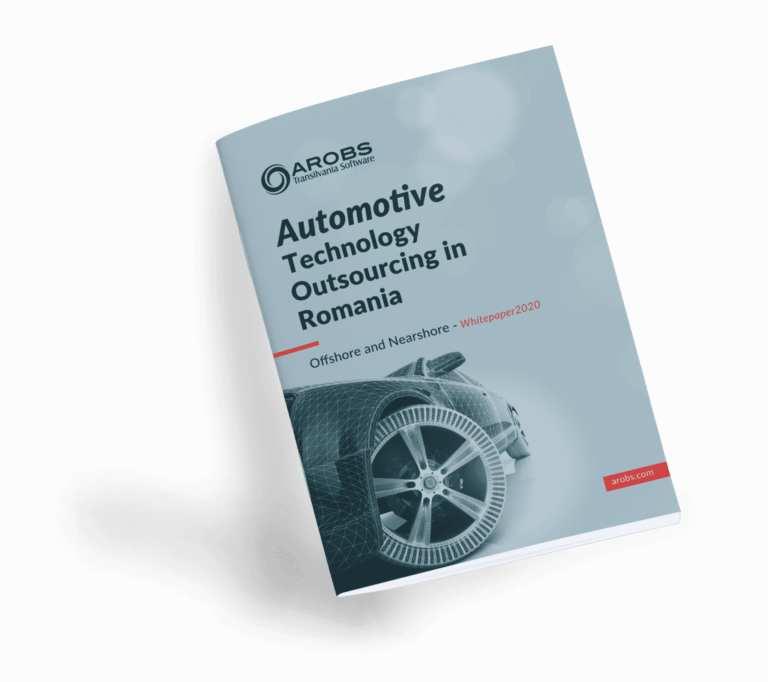
Automotive Technology Outsourcing – Romania – Offshore and Nearshore
The automotive industry is at a turning point. Leading companies have long recognized this shift and are now turning it to their advantage. But changing the structure of company or industry needs investment.
These are the times in need of two main resources, talented professionals, and cost-effectiveness.
Hence, Romania becomes one of the main automotive technology outsourcing destinations. This sector employs over 230 000 people and contribute to the national GDP with 27%.
The only way towards a positive future for the automotive industry is through partnership.
// Arobs Transilvania Software
Latest case studies
Our clients share the experiences they had working with us. AROBS case studies explain our most provocative projects.